Interest, innovation, and investment in data and AI have surged in recent years. Every company wants to be data-driven. Every CEO wants to know what AI can do for them. Everyone wants to disrupt their industry and build a future around AI.
Key Takeaways
- Flip the Mindset – Data for Strategy: Stop asking what your business can do for AI. A successful strategy focuses on what data and AI can do to achieve your wider business objectives – moving from a technical “shopping list” to a blueprint for commercial advantage.
- Bridge the Production Gap: With 95% of AI proofs of concept failing to reach production, leaders must move beyond isolated experiments. Success requires closing the gap between inflated hype and delivering reality by treating data and AI as intertwined capabilities rather than separate threads.
- The Lighthouse Approach: Avoid multi-year “mega-programmes” that lose momentum before delivering value. Instead, use Lighthouse Projects—deep and narrow initiatives that use a Minimum Valuable Product to unlock measurable business value in just 8 to 12 weeks.
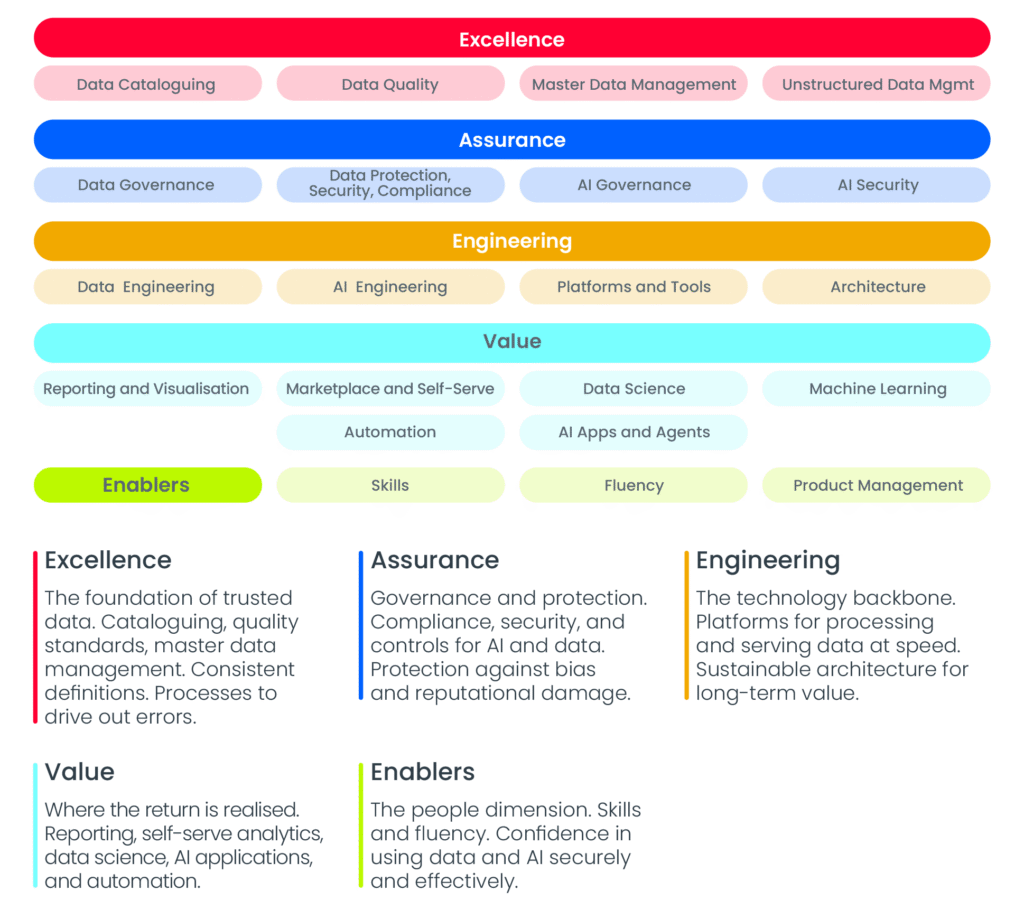
- Build Capability, Not Just Technology: True success isn’t plug and play. It requires orchestrating People, Process, and Technology across five critical layers: Excellence (Foundations), Assurance (Governance), Engineering (Backbone), Enablers (Skills), and Value (Applications).
Read the Full Guide
Who is this Guide for?
This guide is for CDOs, CIOs, and business leaders who want to cut through the noise. It’s for you if:
- You have been burned by shelfware strategies that never left the page.
- You are frustrated by AI pilots and proofs of concept (POCs) that fail to scale.
- You are sceptical of vendors promising “silver bullet” solutions.
- You need to bridge the gap between mature data capabilities and the actual business value they deliver.
Every organisation is different. Some are just starting their data and AI journey. Others have mature capabilities but struggle to extract value. This guide meets you where you are. The principles apply to whatever your starting point.
Why Now?
AI is here to stay, and the window to secure a competitive advantage is narrowing. Organisations that get this right will pull ahead. Those who do not will find it hard to catch up.
- Gartner predicts that over 40% of agentic AI projects will be cancelled by 2027. Read more about the future of AI Agents.
- Research suggests that 95% of AI proofs of concept never make it to production.
- 60% of AI projects unsupported by AI-ready data will be abandoned by 2026.
- IBM 2025: only 26% of CDOs trust their data to support AI.
These are not technology failures. They are strategy failures. Organisations treating data and AI as powerful tools and realising AI’s critical dependence on data to re-engineer business models for value are seeing real returns. In 2024, an IDC report sponsored by Microsoft found that for every $1 a company invested in generative AI, it returned $3.7.
Find out more about our Generative AI project success.

Expert Data & AI Strategy Insights from Joe Horgan
Head of Proposition at Oakland Everything Data
Remind Me, What is a Data and AI Strategy?
With data and AI, most organisations don’t struggle because they lack data, tools, or ideas. They struggle because effort is scattered. Without a clear strategy, initiatives compete, platforms underperform, and teams lose focus. Activity increases, but impact doesn’t.
When it comes to data and AI, we’re talking about orchestrating complex technologies with people and process to achieve lasting value. That’s not going to happen by chance or through off-the-cuff improvisation. You need a clear vision and plan.
In a nutshell, a data and AI strategy outlines how an organisation will use data and AI to achieve its broader business objectives. Rather than focusing on specific technologies or isolated initiatives, it should create a clear overall purpose and direction. It explains how data and AI will deliver critical advantages such as improved decision-making, better experiences, and stronger performance.
Think of it as a living document that captures your vision, case for change, ‘big bets’ and the pragmatic plan that makes it all happen.
Why Do We Need One?
We live in a time of rapid technological change. Data and AI technologies are advancing quickly, expectations are high, and the pressure to act is real. But real success is not just a case of ‘plug and play’. Without a clear strategy, businesses risk fragmented investment, disconnected use cases, and limited return on effort. The result will be a whole heap of frustration and friction, but not much to celebrate.
A strong data and AI strategy cuts through the noise. It creates alignment around what matters, focuses investment on the opportunities that count, and provides a framework for delivering value now while building for the future.
In short, it ensures data and AI are not pursued for their own sake, but used deliberately to deliver measurable, sustainable business value.
Done properly, it will help you:
- Build a unified vision of the future and the value you want to unlock.
- Creates a compelling case for change and to secure investment.
- Aligns stakeholders behind a clear, shared direction.
- Connect data and AI activity directly to valuable business outcomes.
- Bring connection and focus to your data and AI initiatives.
- Create a clear plan and roadmap to guide successful implementation.
- Build trust, shared language, and confidence in data-driven decision-making.
Above all, a data and AI strategy will give you a compelling story, one that explains not just what you want to change, but why it matters and how value will be realised.
Signs You Need a Data and AI Strategy
How do you know if you need a data and AI strategy? Or if your current one needs a refresh?
Here are the warning signs we see most often.
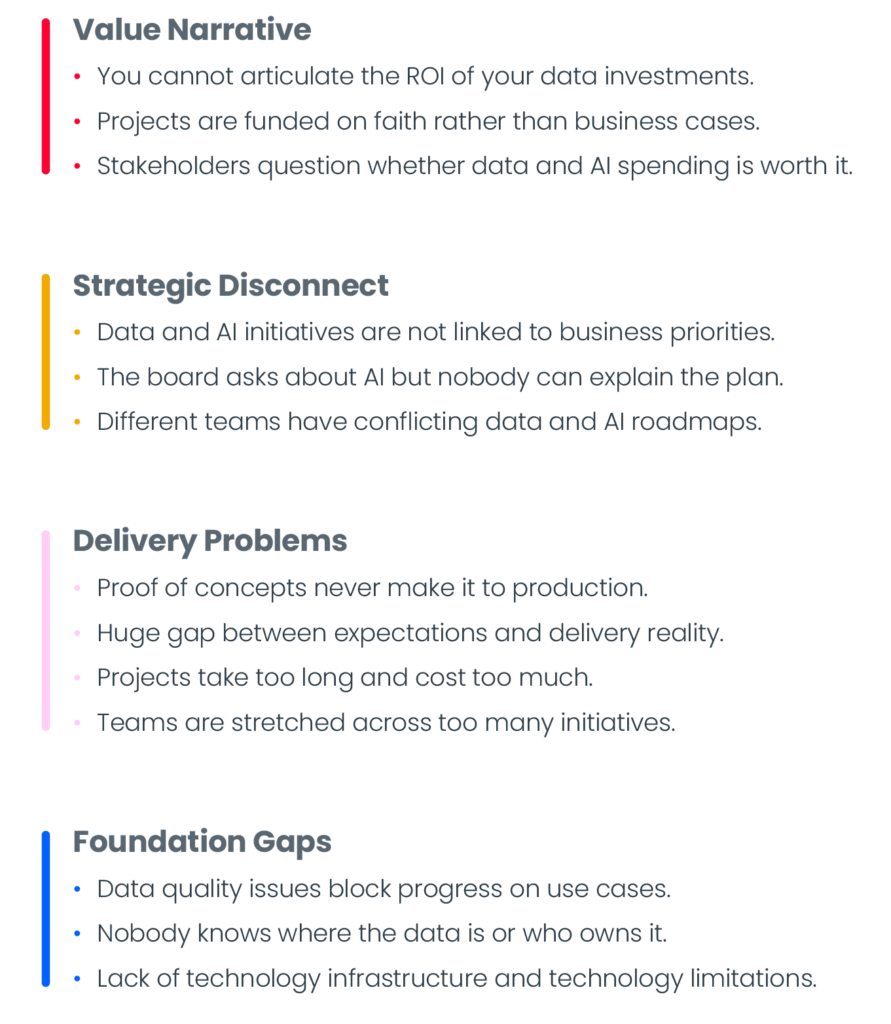
If these sound familiar, you need a strategy. Or the one you have is not working. But not all strategies are created equal. Having a strategy is not the same as having the right one; there are pitfalls.
Data and AI Strategy Self Assessment
Use these questions to evaluate your current position.
Be honest. The answers will help you prioritise.
Strategy and Alignment
- Can you articulate how data and AI support your top three business priorities?
- Is there a single agreed data and AI strategy across the organisation?
- Do business leaders understand and own the data and AI agenda
Value and Outcomes
- Can you quantify the value delivered by data and AI in the last 12 months?
- Do your use cases have clear business cases with measurable outcomes?
- Are stakeholders satisfied with the return on data and AI investment?
Capabilities and Foundations
- Do you trust your data enough to make critical business decisions?
- Is data governance embedded in how people work, not just documented?
- Do you have the skills and capacity to deliver on your data and AI ambitions?
Delivery and Execution
- Do proofs of concepts regularly make it to production?
- Are projects delivered on time and within budget?
- Is there a healthy balance between quick wins and long-term foundations?
Culture and Adoption
- Do people across the business use data to inform decisions?
- Is there enthusiasm for data and AI, or resistance and scepticism
- Are data and AI seen as enablers or as IT projects?
Implementation Readiness
- Do you have a clear understanding of your current state?
- Have you identified your most pressing business pains?
- Do you have a roadmap for data and AI delivery?
- Are the right resources in place to execute?
- Is there a clear implementation plan with owners and timelines?
If you answered no to more than half, your strategy needs attention.
We can help.
The Five Pitfalls
We’ve seen many data and AI strategies fall flat. Organisations create vision documents yet struggle to turn them into action or delivery quickly runs out of steam. The same patterns tend to emerge, and recognising them early can save considerable pain.
01: Unclear Value


Many strategies paint an ambitious picture but leave the value case vague. The slides look impressive, yet no one can explain the commercial difference they will make. Without that clarity, the strategy struggles to win support beyond the team that wrote it. It becomes shelfware rather than a catalyst for change. Strategic use cases are key to a successful strategy as they are the bridge between users, value and foundational investment.
Data and AI is no different to any other investment. It needs to deliver value.
02: Fragmented Strategies


Too often, data and AI strategies exist in isolation from IT, digital, and business strategy. Everyone has a plan, but they all pull in different directions. Data sits in one silo, AI in another, and digital in a third. None of them connect to what the business actually needs. Data and AI strategies are most effective when they position AI and especially data as strategic unifiers that underpin multiple aspects of a companies strategy.
Data is not a parallel work stream. It is the foundation for wider technology change. Digital, AI, and business transformation all depend on it.
03: Partial Answers


Vision alone is not a strategy. Organisations often describe a future state without defining how it will be delivered. Without the supporting detail such as a roadmap, operating model or clear business case teams lose direction. People and process are left behind, momentum fades, and delivery becomes fragmented. When progress can’t demonstrate value, confidence drops and investments stall.
An effective strategy to deliver sustainable value requires a full picture across people, process, and technology.
04: Technology Biased


Too many data and AI strategies read more like a tech shopping list than a coherent plan to deliver commercial value. The strategy focuses on technologies, not people and processes. Organisations lead with technical solutions and treat data as a by-product. They under-invest in people and process. Implementation fails to show ROI. Technology investments are stranded. Nobody thought about adoption, skills, or ways of working.
Capability requires orchestrating people, processes, and technology. Not just buying tools.
05: Jam Tomorrow


Some roadmaps promise transformation but ask stakeholders to wait years for tangible value. Momentum fades, patience runs out, and projects get cancelled. In the fast-moving world of AI, no organisation can afford to wait, and few will. Strategic use cases are critical for delivering early value and building confidence, but they shouldn’t be positioned in opposition to foundational work. The strongest strategies recognise that use cases create focus and momentum for the foundations, while strong foundations enable increasingly impactful use cases. Progress comes from learning by doing, not from choosing between false dichotomies.
Balance matters. Deliver value now while building foundations for the long term.
A Different Perspective
There’s a common thread running through all these pitfalls. It’s about approaching the problem from the wrong direction.
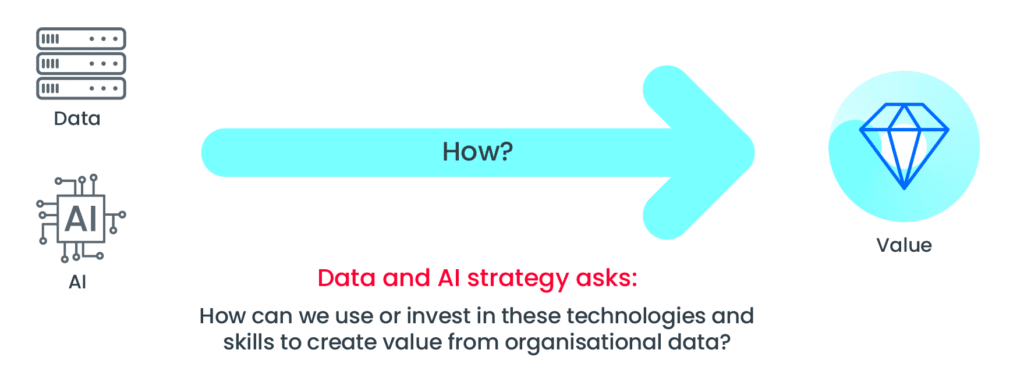
Too many data and AI strategies focus on what the organisation should do for data and AI. Not what data and AI can do for the organisation. They read more like a shopping list for the data team than a blueprint for driving commercial advantage.
You need to flip your mindset and look outwards. It sounds strange, but a data and AI strategy shouldn’t be a strategy for data and AI. It’s data and AI for strategy.
It’s Data and AI for Strategy, Not Strategy for Data and AI
Isolated, technology focused strategies are doomed to fail. You must look outwards and towards value.
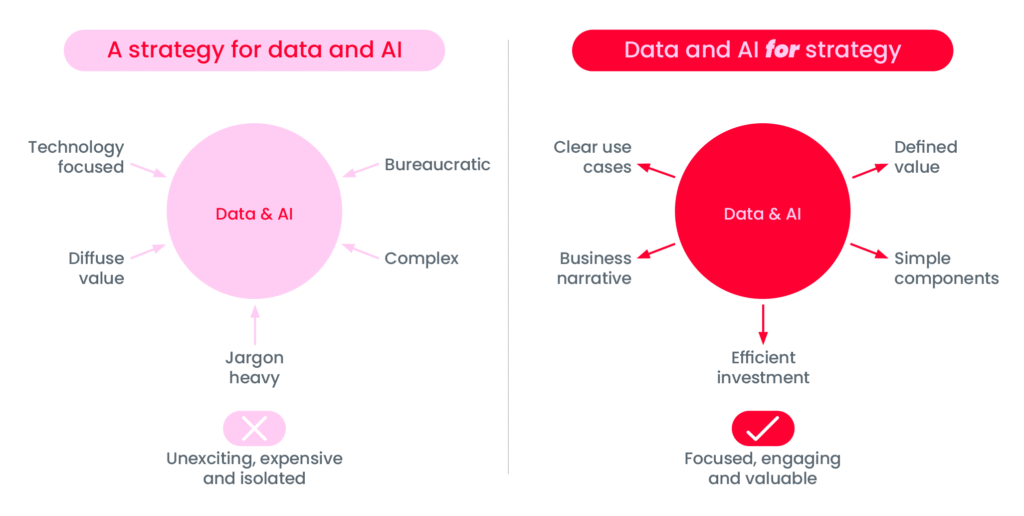
The difference matters. Strategies that look inward become technology-focused, bureaucratic, and jargon-heavy. They offer scattered value and leave stakeholders cold. Strategies that look outward start with clear use cases and a business narrative. They define value, simplify components, and drive efficient investment.
So, borrowing from JFK, “ask not what your business can do for data and AI – ask what data and AI can do for your business.”
Value: Putting Data and AI as a Core Part of Your Organisational Strategy
It’s best to think of your organisational strategy driving towards a common purpose and goals. It’s a data and AI strategy, not an isolated or parallel document.
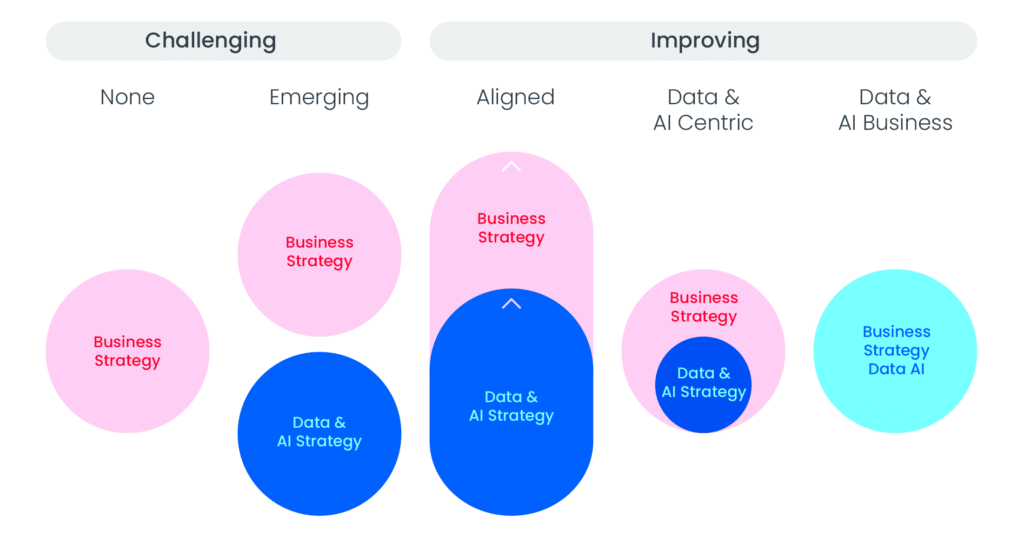
Nothing will change until you put the organisation first. Data needs to be a means to meet organisational needs, not an end in itself.
And simply aligning objectives isn’t enough anymore. Data and AI need to sit at the core of organisational strategy. Think of them as a key chapter in the overall business plan, not an appendix. Data and AI should be woven into every part of what you do. This is how you maximise the value.
Many organisations struggle with this shift. Even when the mindset changes, you can easily get stuck. Every data strategy must be custom-shaped to your organisation. You can’t cut corners with cookie-cutter blueprints. Well, you can, but it won’t end well.
However, you can apply a structured process to help your team discover, design, and deploy a compelling data and AI strategy. One that creates a path from where you are today to a data-driven future. Sadly, most data and AI strategies fail to create that path. If you follow your hard-earned wisdom, yours will.

“A business-aligned roadmap is crucial.
“Without it, data and AI initiatives become disconnected projects rather than strategic capabilities.”
Andy Crossley, CTO at Oakland Everything Data
Where are We Aiming with a Data and AI Strategy?
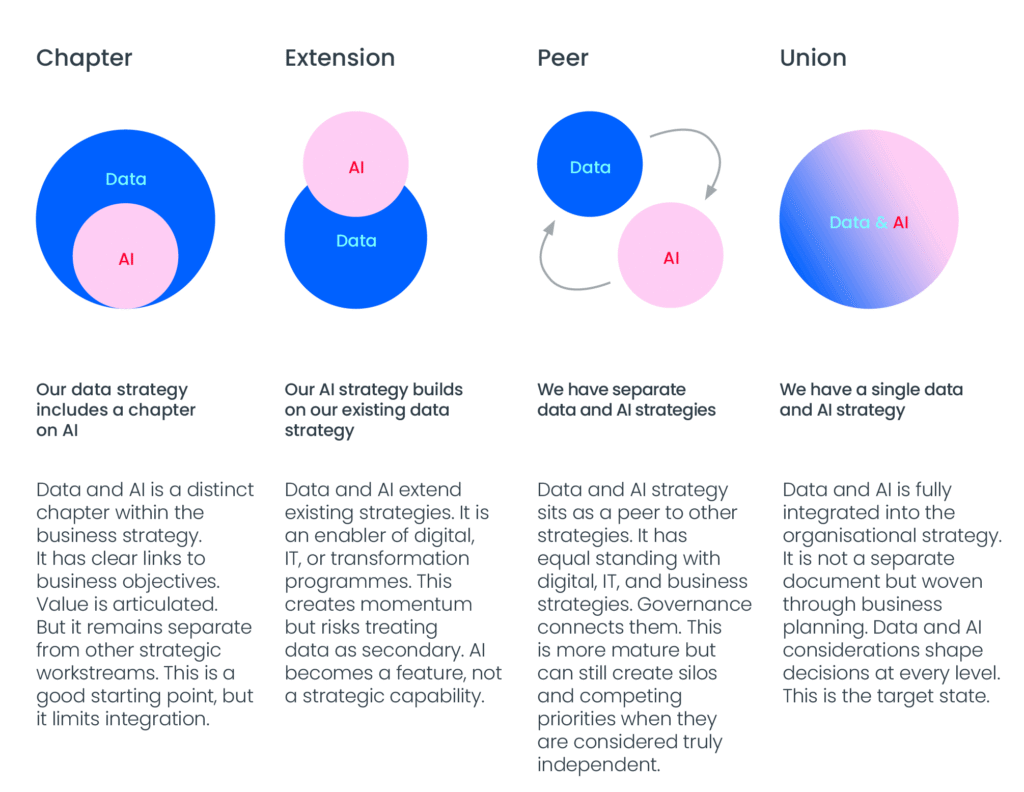
Organisations approach data and AI strategy in different ways, shaped by their context, maturity, and priorities. Understanding your current position is essential to planning what comes next.
In our work with customers, we see four common strategic postures. These are not maturity stages, but different ways organisations choose to relate data and AI. AI has attracted increased attention in recent years, prompting many organisations to reconsider how they approach it strategically and how it connects to their data foundations. In some cases, AI builds on existing data capabilities; in others, it exposes gaps that need to be addressed.
There are no right or wrong answers. What matters is having a clear, deliberate position on both data and AI, and a shared understanding of how they relate to each other.
Five Guiding Principles
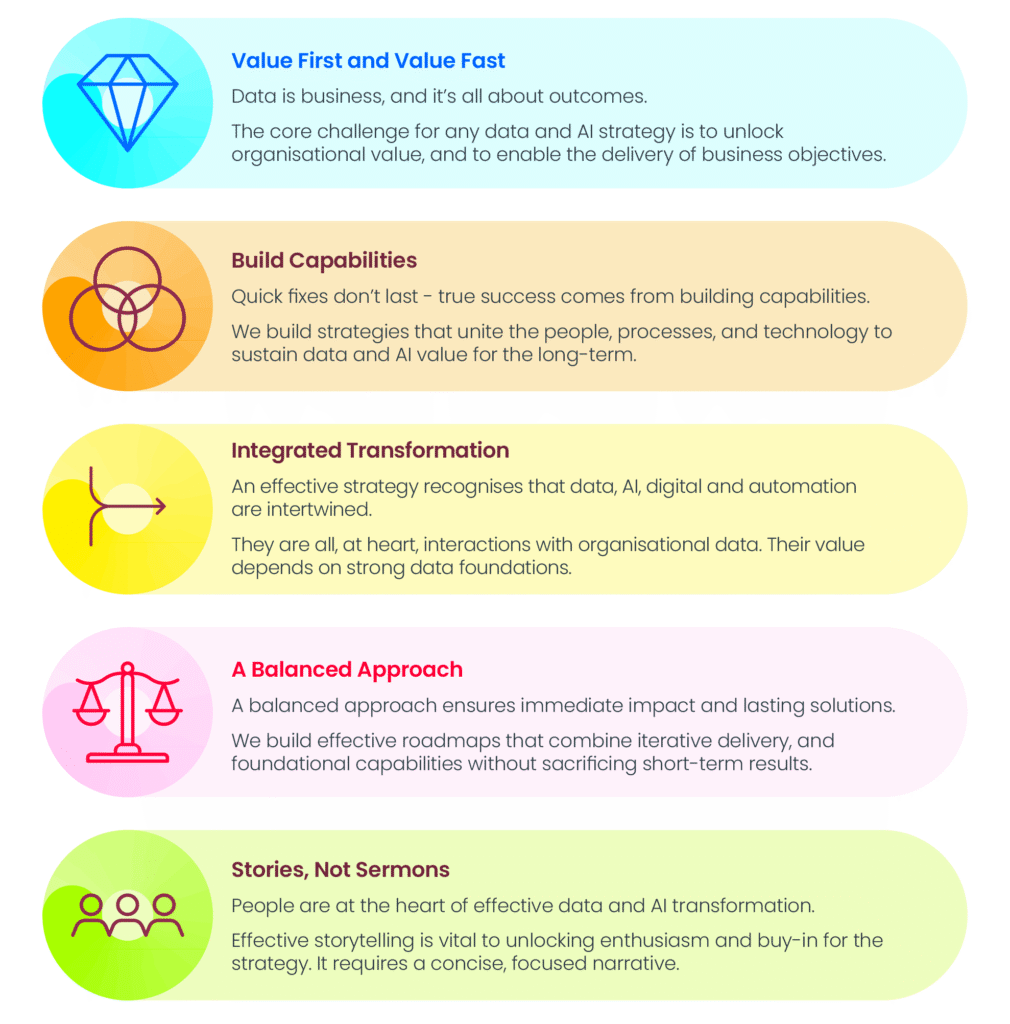
This can feel like a lot to take in, and it isn’t always easy. But over decades of hands-on experience helping organisations succeed with data and AI, we’ve seen clear patterns emerge.
While every organisation is different, the most successful transformations share common approaches. These are the principles we’ve seen work time and time again and the foundations behind our approach to delivering lasting value from data and AI. You can read more about each of these five principles on the pages to follow.
1. Value First and Value Fast
This needs to be your constant north star when you are thinking about your strategy’. It means thinking hard about use cases, routes to value and what truly matters to your organisation’. Everything you create needs to be subordinate to this aim.
Read our blog on why data is important for business.
Oakland’s Value Framework
Value comes in many forms. Increased revenue. Reduced costs. Improved compliance. Better customer experience. Operational efficiency. You must define your value drivers. Define where you will create value through strategic use cases. Without this clarity, you are building castles in the air.
Our value framework helps you identify where the opportunities lie. Identifying areas of value opportunity from data.
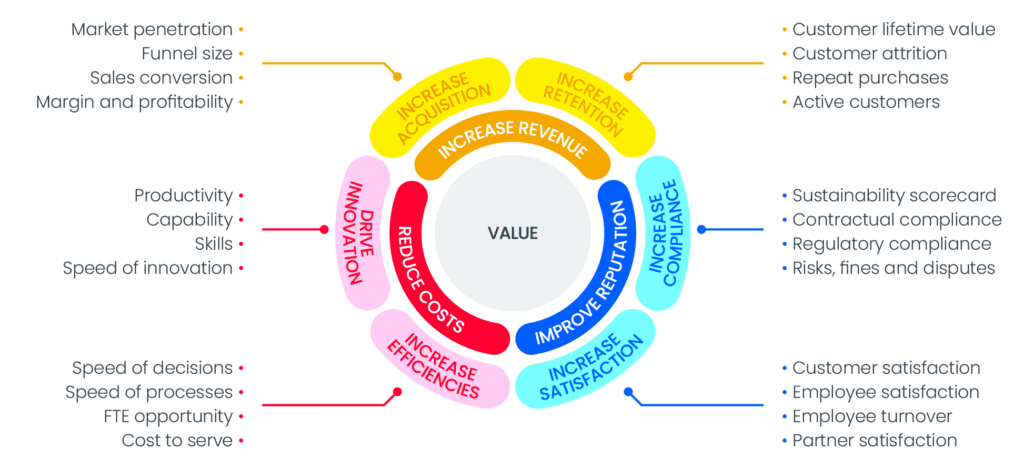
Before you can deliver value, you need to define it. Where will data and AI make a difference? What outcomes matter most? Value is not abstract. It falls into clear categories. Understanding these helps you identify opportunities and build compelling business cases.
Seven Value Drivers
Every use case should map to one or more of these drivers. If it does not, question whether it belongs in your strategy.
How to Quantify Value
This can be when it gets hard, but there are a few things you can do to help you size value quickly. Although you might need some help from your friends in other departments.
The next three approaches help you to quantify opportunity.
- Existing Benefit Cases
Start with what you know. Review past projects and pilots. What value did they deliver? What could similar initiatives achieve at scale? This grounds your estimates in reality.
- Sensitivity Analysis
Model the range of outcomes. What if we improve conversion by 1%? By 5%? What if we reduce churn by 0.5 percentage points? Minor improvements in big numbers create compelling cases.
- Sector Benchmarks
Look outside your organisation. What have peers achieved? What do analysts report as typical returns? Benchmarks provide credibility and context for your estimates.
Combine all three for robust business cases. Triangulate your estimates. Be honest about assumptions. Stakeholders respect rigour.
2. Build Capabilities
Quick fixes do not last. True success comes from building capabilities. These sustain the value of data and AI for the long term.
Many organisations over-invest in technology. They neglect culture, governance, and process. A better approach is through the lens of capabilities. What does your business need to do with its data? This impact goes beyond AI to add value across the organisation.
Buying technology is transactional and narrow. Creating capability requires orchestrating people, processes, and technology. It opens a wider perspective and avoids the pitfalls of scattergun hiring or chasing technology for its own sake.
Need help with Data Governance? Read our guide.
The Capability Framework
Capabilities are the building blocks of data and AI success. They span five layers. Each layer must work for the others to deliver value.
3. Integrated Transformation
An effective strategy recognises that data, AI, digital, and automation are intertwined. They are all interactions with organisational data. Their value depends on a strong data foundation.
Data is the Fuel of Technological Transformation
At heart, almost all aspects of modern transformation are based on data interaction.
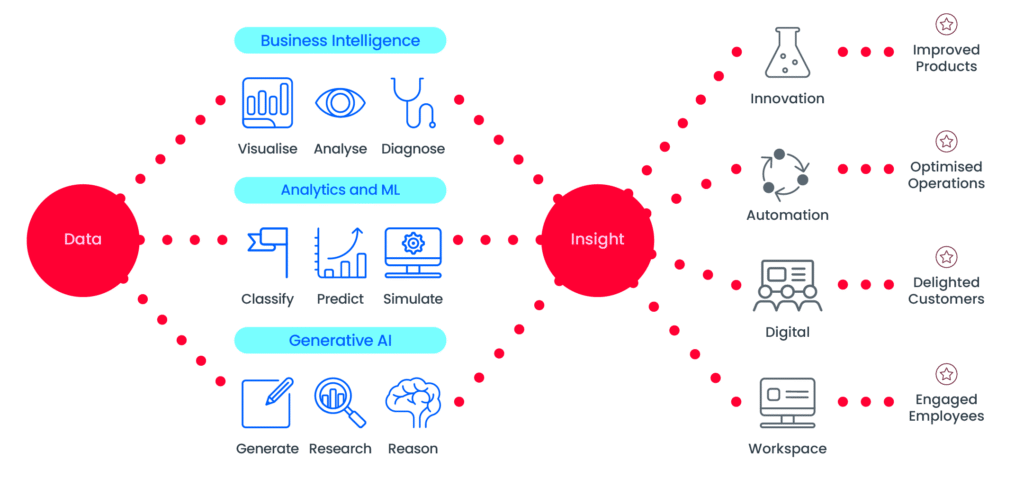
Many companies struggle with fragmented efforts. Data, analytics, digital, AI, and IT all have separate plans. They pull in different directions.
A good strategy positions data as a unifier. It underpins technological transformation across data, digital, AI, and IT, and connects to customer and employee experience. It avoids internal friction and fragmentation.
4. A Balanced Approach
A balanced approach ensures immediate impact and lasting solutions. Effective roadmaps combine iterative delivery with foundational capabilities. They do not sacrifice short-term results.
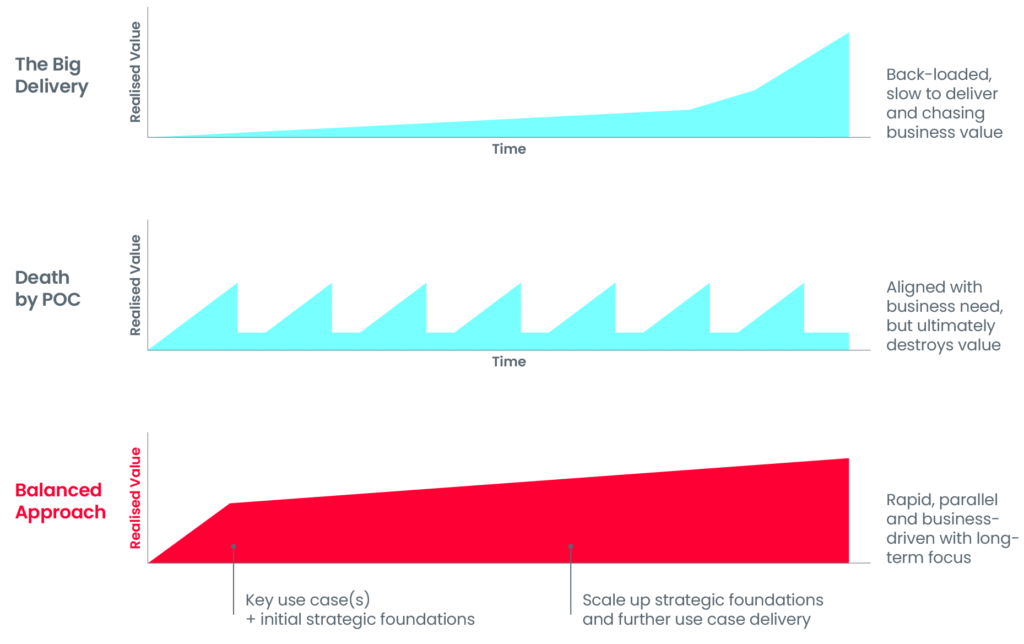
Two common failure modes sit at opposite ends of the effort spectrum. The first is “death by POC”, which we cover in our AI guide: The Business Guide to Generative AI. Often led by technology, teams hunt for quick wins. Early momentum fades, and value is never sustained. The second is “the big delivery”. Heavy investment, slow or no value, the business loses patience. Projects get cancelled.
The balanced approach avoids both traps. It runs use-case delivery and foundation-building in parallel. Use cases build momentum and prove value quickly. Foundational work ensures that value can scale.
The trick is seeing these as complementary. Not opposed. Use cases tell you about the capabilities you need. Foundational capabilities enable use case delivery. For sustainable transformation, these must be interconnected.
Across the IT landscape, data and AI can no longer be bolted on later. Every business transformation decision either opens or closes future options. Build data thinking from the start, and you position yourself to act when opportunities arise.
This is not just a technical challenge. It is about skills, literacy, and ways of working too. The aim is to build maturity incrementally across people, processes, and technology.
Making It Happen
We have helped many organisations on their data and AI journey. What have we learned? Winners are not the ones with fifty proof-of-concept. Nor are they launching five-year mega programmes.
The winners picked their battles and executed well. They balance delivering now with building long-term capability.
What Does Not Work
- The Big Delivery: Back-loaded, slow, and chasing business value. Nobody waits five years for a strategy to deliver.
- Death by POC: Twenty half-finished projects. Teams stretched thin. Budget scattered. Everyone is frustrated.
What Does Work
- A Balanced Approach: Rapid, parallel, and business-driven with long-term focus.
- Use cases inform foundational needs. Foundations set the cadence for use case delivery.
- They are the same effort, not opposed.
The Lighthouse Approach
Many strategy implementations start wide. They chart ambitious, multi-phase efforts to realise eventual value. But scope creep and internal complexity undermine the project. Many are cancelled or lose their way before value is delivered.
We prefer deep and narrow. Using a Minimum Valuable Product, a Lighthouse Project rapidly unlocks a value slice. Initial delivery creates momentum. It shows a way of extending value iteratively.
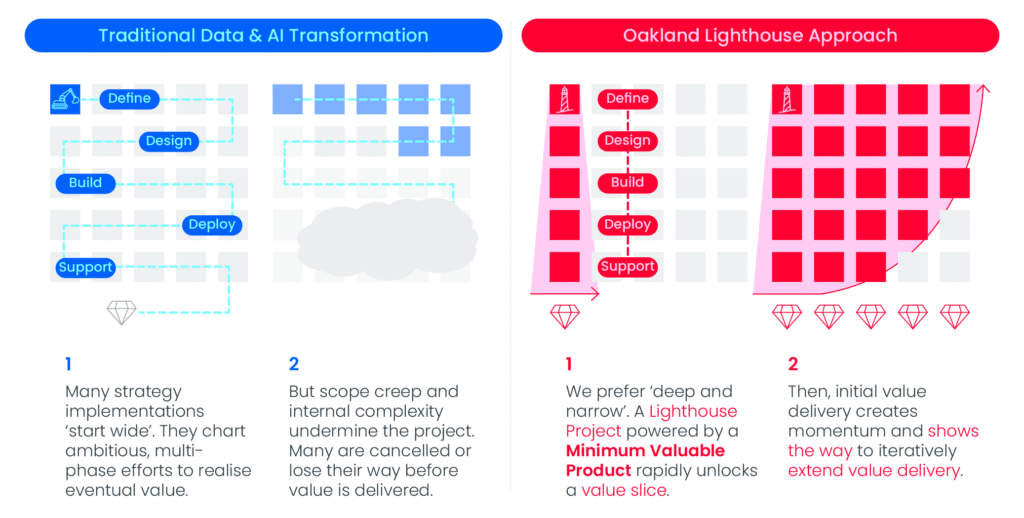
Your first Lighthouse Projects do more than solve specific problems. They build belief. They create advocates. They develop capability. They teach you what data and AI can do for your business.
Selecting Your Lighthouse
Not every use case makes a good Lighthouse. Look for a clear value that stakeholders understand and care about. It should be achievable in 8 to 12 weeks with available resources. Choose something that builds capabilities transferable to other use cases. You need an engaged sponsor who will champion success. And the data must be accessible or made so quickly.
Perfect is the enemy of good. Start narrow. Go deep. Build something real. The rest will follow.
Ready to build your Lighthouse Project? Drop us a line.
5. Stories, Not Sermons
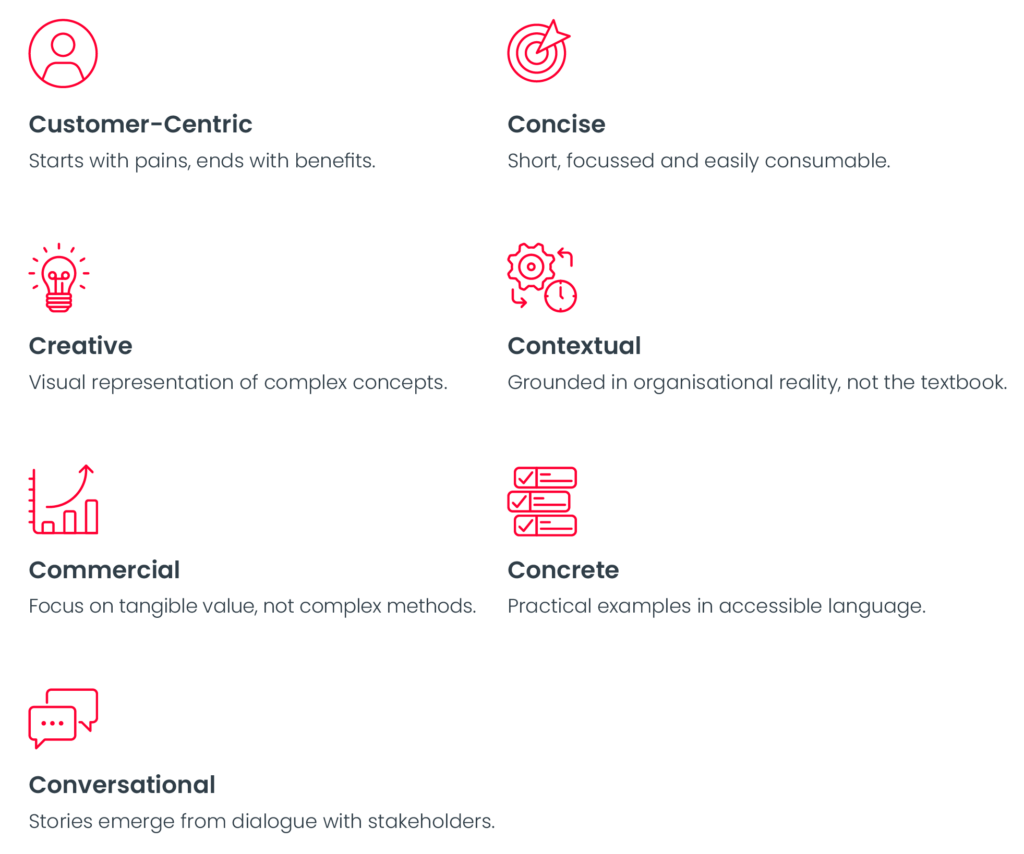
Data and AI strategy is more than anything a storytelling challenge. Too many strategies are long, technical and leave audiences cold. Nobody wants a fifty-slide presentation about data mesh. Not many people live their day-to-day life in data and AI land, they won’t all be evangelists like you. So if they can’t see the value and case for change, they won’t back it. A strong narrative is non-negotiable!
The Path to Success
So…
…do you feel ready to go? Here’s how we tackle it at Oakland.
Our five phases lead to a strategy ready for implementation:
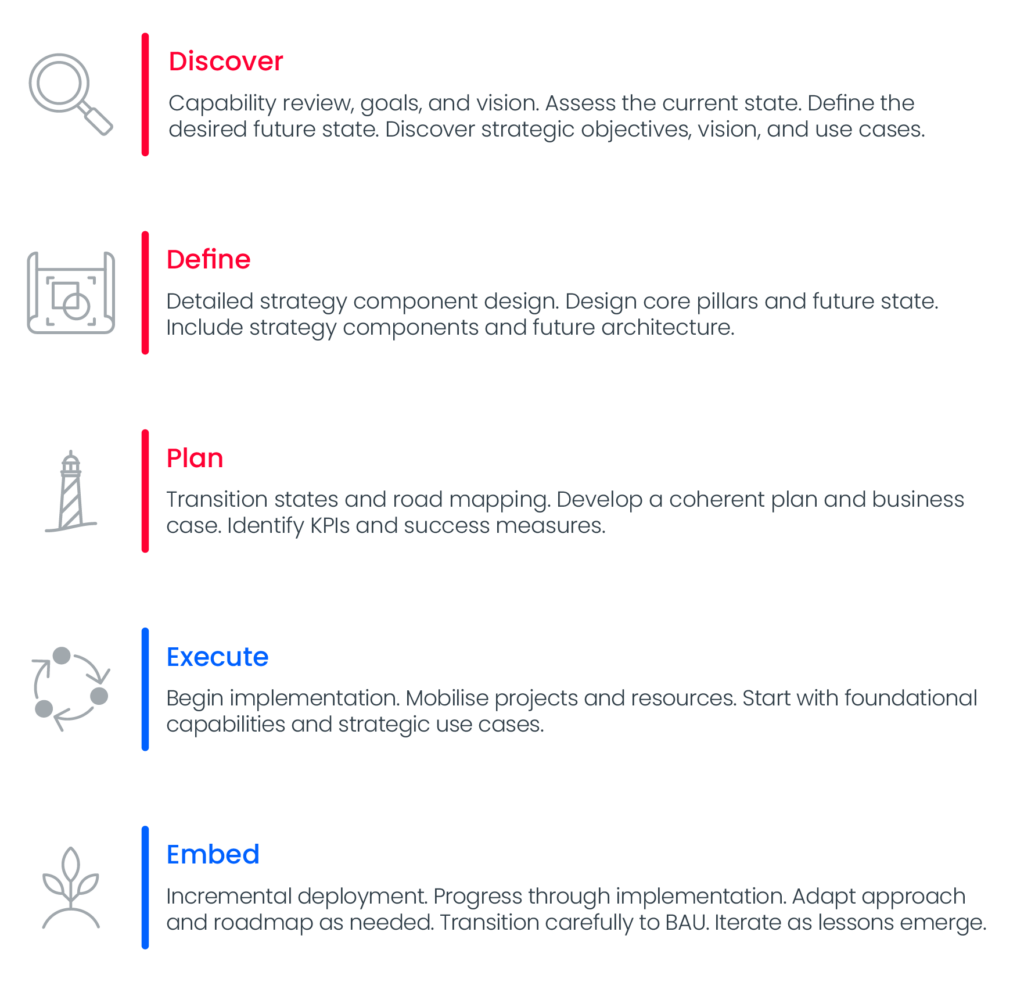
Typical timescales
The Discover, Define, and Plan phases typically take 6-8 weeks to develop a strategy. Lighthouse implementations then run 8-12 weeks to demonstrate value.
Data and AI Strategy Partners to Some of the UK’s Biggest Organisations










Our Approach Works
Hear from organisations that have transformed their data and AI capabilities with Oakland.
“The data strategy is a hugely important piece of work that will put our own use of data at the heart of how we operate and transform as a regulator.”
Rob Holtom, Executive Director of Digital, Data and Technology, ICO


“The Oakland team did a great job in analysing and defining the data definitions, quality rules, and governance for this use case.
“Their professional approach in collaborating with both the business and data teams has reinforced the importance of using our data in a more controlled and trustworthy manner.”
Mike Brace, Director of Data Operations & Strategy


How Oakland can Help
Oakland and Softcat: Two Powerhouses, One Purpose
We’ve spent 40 years helping businesses unlock serious value from their data. Now as part of the Softcat family, we’re combining Oakland’s deep data expertise with Softcat’s unrivalled IT infrastructure and vendor relationships.
We’re still the same straight-talking, client-obsessed Oakland team, operating independently with our own voice and values. But backed by one of the UK’s most trusted tech partners, we deliver even more firepower for your data and AI challenges.
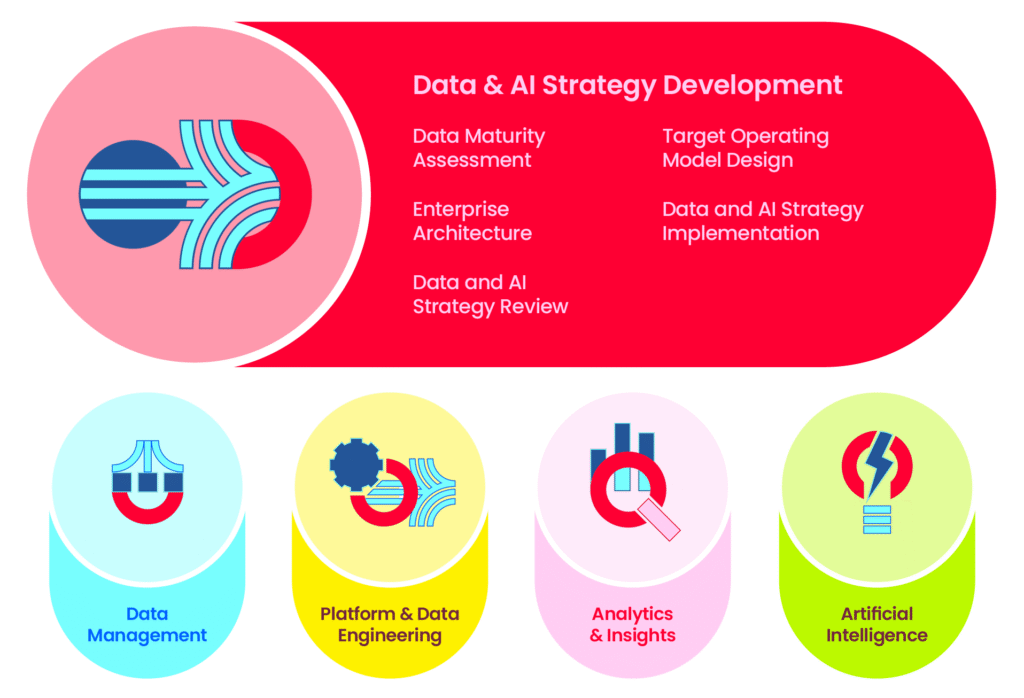
Why Choose Oakland’s Data And AI Strategy Services?
Traditional data and AI strategy consulting falls short. At Oakland, we do it differently. We’re strong believers that data and AI strategy consulting should be pragmatic, outcome-driven, and built for long-term success – all while delivering immediate value.
Through our ‘Everything Data’ lens, we ensure your data and AI strategy isn’t siloed. We take a holistic approach, aligning your data and AI strategy with that of your overall business.
Our data and AI consultants help you to find the right use cases and unlock value through ‘lighthouse projects’. We enable data and AI, and technology to drive measurable business outcomes.
Download the Full 2026 Data & AI Strategy Guide
Get the complete 27-page blueprint, including our full value framework and detailed implementation roadmap.
Speak to an Oakland Expert
Ready to launch your first Lighthouse Project? Contact our team to discuss how we can help you close the gap between hype and reality.