
The Enterprise AI Reality Check
You were probably expecting another AI primer. A year ago, any half decent ‘Guide To AI’ would start with explaining generative models, throwing around buzzwords like ‘agentic’, and promising plug-and-play transformation.
But here’s the thing: you already know all that. You’ve seen the demos. You’ve read the headlines. Your parents have stopped Googling and started GPTing instead.
So, let’s skip the tech talk. The question isn’t ‘What can AI do?’ anymore. It’s ‘why does AI work brilliantly everywhere except inside your business?’
Your phone’s camera makes you look like a professional photographer. Netflix knows exactly what you want to watch. Even your car parks itself. But ask AI to help with actual work (reading project reports, spotting risks, finding expertise) and suddenly it struggles with the complexity hidden in our everyday work. A recent MIT study reported by Forbes found that 95% of AI proof-of-concepts fail.
That’s not a technology problem. It’s an application problem. The 95% fail because they ignore what actually matters: getting their data ready for AI and picking the right projects.
The 5% that succeed. They do the hard work first. They design for actual workflows. They focus on the data and integration. They make AI fit their messy, complex, decidedly human business reality.
Here’s what we’ve learned at Oakland and what our experts (not marketers or ChatGPT) wanted to share in this guide: AI success follows the same rules it always has. Get the right tools to extract the right insights from the right data. Make better decisions. Generative AI is powerful, yes. But it’s still just another tool.
Success depends as much on your data as on the AI you choose.
If you want to win with AI, you need to get your data talking first.
Five Common AI Pitfalls


1. The Moonshot Mistake
AI is expected to solve everything: business efficiency, customer service, competitive edge, and even make better coffee.
Some enterprises continue to use AI for the wrong things. They want it to deliver blue-sky strategies, innovate independently, and transform
at the click of a button. Big moonshot projects that look impressive in presentations often fail to deliver.
Many large companies have faced the harsh reality of AI’s limitations when expecting it to revolutionise everything simultaneously. The pattern is consistent: ambitious AI projects aimed at replacing high-level thinking and strategic decision making fail. Meanwhile, back-office automation quietly succeeds.
Here’s the truth: AI excels at specific, repetitive tasks. It’s brilliant at reading documents (even those 97-page ones nobody else will), spotting patterns, and automating boring work. It won’t replace your strategy team. It won’t revolutionise creativity. But it will handle the tedious work that makes people groan. It will deliver efficiency and allow your people to do what you’ve always wanted them to do: solve the big problems and innovate.


2. Proof-of-Concept Paralysis
These high expectations, combined with cheap AI access, tempt businesses to try everything at once. They often get bogged down spinning up endless proof-of-concepts, which spreads resources too thin and fail to deliver.
With Gen AI, the most powerful machine learning models are available for fractions of a cent per API call. With such a cheap, mighty hammer,
everything looks like a nail. The temptation becomes irresistible implement AI everywhere, for everything, all at once.
This creates the proof-of-concept trap. Projects get proposed, built, and then fail to impress. Resources scatter. Nothing gets proper attention. Frustration and disillusionment follow.


3. Getting Lost in the Technical Jungle
Making matters worse, the AI landscape changes weekly. New models, new frameworks, new vendors, all claiming breakthrough results. Attend
any AI conference and you’ll face 400 sessions and 180 vendor booths, all promising to transform your business.
Teams freeze, paralysed by choice. What if we pick the wrong tool? What if something better launches tomorrow? So, they wait. And wait. Meanwhile, competitors who pressed ahead are already seeing results.
The lowered barrier to entry has also created a forest of startups promising useful AI wrappers. Sure, new options launch monthly. But
while you’re waiting for the perfect solution, your competitors are already automating their back office with tools that work today. The best AI solution is the one that solves problems today, not the one that might exist next year.


4. Data quality: A fork in a world of soup
Think of AI as a powerful lens for viewing your data. Let’s start with the obvious truth: your AI is only as good as your data. If that data is wrong, incomplete, or outdated, AI just magnifies those problems.
But … what does ‘data quality’ even mean in the world of Gen AI and unstructured data? It’s hard to see how traditional data quality methods apply to the unstructured data sources that Gen AI can unlock.
Try tackling unstructured data armed only with a typical data quality toolkit, and you’ll feel like a fork in a world of soup. Suddenly, you’re juggling blurrier, slippery concepts.
With ‘relevance’, ‘meaningfulness’ and ‘conformity’ living alongside the comforting, clean lines of ‘completeness’, ‘validity’ and ‘accuracy’, that have been the guiding lights of data quality for decades.
At Oakland, we see this constantly. Teams rush to implement AI, then wonder why it’s not delivering. They blame the technology when, in reality, they skipped the hard part: thinking deeply about how they gather, assure and protect the information the AI will use to create its own store of knowledge.


5. The Integration Nightmare
Even with the right tool, focused use case, and clean data, there’s one last hurdle. Integrating AI with your existing systems and processes.
Too often, AI gets crowbarred into workflows without the right information, tools, or context. It can’t access key systems. It doesn’t understand how your business operates. People forget to adjust processes or train users properly.
The result? Friction, frustration, and failed projects. Another AI initiative that proves the sceptics right. Gartner’s seen this film before. Every technology follows its ‘hype cycle’: massive excitement, crushing disappointment, and then muted success for those who stick with it.
We’re entering the ‘trough of disillusionment’ for AI right now. But that is great news. It means the tourists are leaving, and the serious work can begin.
The businesses that adapt their processes, train their people, and properly integrate AI are the ones that will succeed. They’re the ones who’ll be quietly winning while everyone else is still arguing about which model to use.
As we know, the pragmatists always win. Eventually!
Bridging the Gap
So, those are the traps. The moonshots that crash. The proof-of-concepts that multiply like rabbits but never grow up. The paralysis, the data chaos, the integration nightmares.
But here’s what’s interesting: once you accept that AI won’t solve everything, you can focus on what it does well. Boring, repetitive, high-volume tasks that waste human talent.
We’ve found three specific problems where AI consistently delivers value. Not because they’re glamorous. Because they’re painful, universal, and perfectly suited to what AI does well. Every business faces them. Most are drowning in them. And unlike moonshot transformations, solving these problems delivers immediate, measurable results.
The Three Big Problems AI Should Solve
Here’s the thing. AI excels at specific, repetitive tasks and handling high volumes of information. Not replacing human creativity. The boring stuff that eats your day, the things that make a task take five hours, not two. Or the task that takes so long you’ll never get around to doing it.
1. The Information Tsunami
Let me take a wild guess: your business is drowning in incoming data. Support tickets pile up faster than teams can read them. Sensors and logs generate thousands of alerts that nobody has time to investigate. Emails sit unread while critical issues hide in all that noise.
AI can handle this flood for you. Every message gets read, categorised, and routed instantly. Priority items surface immediately. Routine queries handle themselves. Your team’s focus is on complex problems and deep work, rather than trying to tune out the noise.
Who benefits most:
- IT departments managing system alerts and monitoring
- Customer service operations processing high ticket volumes
- Operations teams handling IoT and sensor data
- Procurement teams processing supplier communications
- HR departments managing employee queries
But information isn’t just external. For example, product catalogues become their own tsunami. Take one of our clients: they had eight million SKUs accumulated over decades, with thousands of new products hitting the catalogue daily. No consistent categorisation. No way to analyse what really sells.
Here’s what we did:
We built AI agents that read every product description, compared attributes, and created consistent taxonomies.
When uncertain, they searched external sources for validation. Result: over 90% of revenue mapped to clear product categories for the first time in 30 years.
This wasn’t a chatbot answering questions about products. We deployed a swarm of 300,000 AI agents working in parallel, each one reasoning through product codes,
descriptions, and attributes like a human analyst would.
The agents didn’t just match keywords. They understood context. When they encountered ambiguous products, they researched online for specifications and cross-referenced industry standards. They learned the client’s specific terminology and adapted to 30 years of inconsistent naming conventions.
Most importantly, this created permanent value. The master product catalogue now underpins all sales analytics. Revenue analysis by category? Previously impossible. Now routine.
For the first time, they could see which product lines were failing. The AI didn’t just process data. It built the foundation for decades of better decisions.
We didn’t stop there. Oakland’s machine learning team built a buying propensity model on top. Result: millions in new sales opportunities. ROI of over 150% in six months.
That’s the difference between generic AI and carefully crafted, process-native solutions. We didn’t force the business to adapt to the AI. We built an AI that understood three decades of messy human reality and turned it into strategic insight.
Could a human have done this? Eventually, sure. Could they have achieved the same speed, consistency, and cost? Not even close. We see AI doing tagging up to 1,000 times faster and over 90% cheaper.
But here’s the question nobody asks: who exactly dreams of spending months categorising eight million products? Reading endless SKU descriptions? Matching product
codes to catalogues on repeat?
This is exactly the valuable-but-mundane work AI should handle. High impact, low reward. Critical for the business, crushingly boring for humans.
When looking for AI projects, ask yourself: Is this task essential but essentially thankless, boring but important? That’s your sweet spot. Let AI handle the repetitive grind. Save your people for work that really uses their brains.
2. The Document Mountain
Your organisation has the answer to every question you want to ask. They’re buried somewhere in thousands of incident reports, lessons learned documents, and project reviews. But nobody can find them. The same mistakes are repeated. The same questions get asked.
This is where AI shines. Natural language processing means users can query years of documentation conversationally. “What went wrong on similar projects?” gets instant, relevant answers. We aren’t talking keyword matching but semantic understanding, where the AI understands what you mean.
Who benefits most:
- Project management offices needing historical insights
- Compliance teams trying to make sense of regulatory documentation
- Engineering teams needing fast access to technical specifications
- Legal departments reviewing contract histories – All of them
- Quality teams analysing incident patterns to spot the ones that matter
Here’s a real example: one of the UK’s largest infrastructure organisations, running capital projects worth tens of millions of pounds, faced exactly this challenge. Thousands of lessons were documented over the years, but the scale and complexity meant nobody could access or get value from this insight. They knew previous mistakes kept repeating.
We built an AI solution that reads and interrogates these lessons semantically. Users ask questions in plain English and get relevant insights instantly. The AI summarises complex lessons, categorises them against regulatory frameworks, and surfaces patterns nobody knew existed.
This wasn’t about digitising documents or building a better search engine. The AI understands context and intent. Ask about “contractor delays in weather-affected regions” and it finds relevant lessons even if they never use those exact words. It connects insights across decades of documentation, identifying patterns human readers would never spot.
The system actively pushes insights to relevant projects. When a new proposal matches historical failure patterns, stakeholders get warned. Time-tofind for critical lessons went from hours to seconds.
Most telling: adoption was immediate. No training needed. Engineers simply asked questions and got answers. That’s what happens when AI is integrated into existing workflows rather than creating new ones.
3. The Expert Shortage
Data often lacks meaning without context. Critical warning signs often go unnoticed because their relevance isn’t recognised. You need experts to
interpret, analyse, and explain. But experts are always in demand, often expensive, and usually stuck answering the same basic questions repeatedly. Your best analysts become human FAQ machines instead of strategic advisors.
AI excels at applying consistent expertise at scale. It can prepare reports, highlight anomalies, and answer complex queries 24/7. Not replacing experts but amplifying them. One specialist’s knowledge becomes accessible to hundreds of users.
Who benefits most:
- Finance teams drowning in complex analysis and reporting requests
- Technical support requiring specialist diagnostics
- Risk management teams monitoring multiple indicators
- Sales teams needing competitive intelligence, yesterday ideally
- Operations teams requiring predictive maintenance insights
We worked with a finance department drowning in ad hoc queries. Every request meant hours of Excel wizardry and SQL gymnastics. Each request delivered value, but it wasn’t maximising the experts’ potential, as it was still repetitive. It meant they couldn’t focus on the big strategic decisions.
We built an AI agent framework that could answer bespoke queries across their data and automate routine daily analysis. Data could be interrogated through follow-up questions or exported for local analysis. This framework required very specific domain knowledge and tight security controls because of the sensitive financial content.
The solution reduced the time-to-insight for routine daily tasks. Previously inaccessible data within the financial ecosystem became available to nonSQL users. Irregularities could be spotted early and rectified, creating real cost savings.
This wasn’t about replacing the finance team. It was about augmenting their capabilities. They spend less time extracting data and more time interpreting it. The AI handles the repetitive SQL queries and data gathering. Humans focus on strategy and decision-making. That’s practical augmentation, giving experts the tools to work at a higher level, to extract more value.
The Common Thread
Look at all three problems. The information tsunami. Mountains of documents.The expert shortage. Every business faces them. The solutions share a crucial aspect: they all involve AI handling the repetitive, time-consuming tasks that humans shouldn’t waste their expertise on.
This isn’t about moonshots or transformation. It’s about removing friction. Let AI read those emails. Let it categorise those products. Let it surface those buried lessons. Your people can then do what only humans can: make complex decisions, build relationships, be creative and drive innovation.
Think of it as augmentation, not automation. Your experts become cyborgs, with the same human judgment and creativity, but with perfect recall, infinite patience, and the ability to process information at machine speed. The finance analyst who can query decades of data in seconds. The project manager who remembers every lesson from every project. The engineer who instantly identifies patterns across thousands of incidents.
We’re not building AI to replace your people. We’re giving them superpowers. Turning million-dollar experts into billion-dollar decision-makers.
That’s Oakland’s approach. We don’t ask if you’re ready for AI. We build AI that’s ready for your reality; messy, complex, and decidedly human.
Oakland’s Perspective: Getting Your Data Talking
In the AI gold rush, everyone’s obsessed with the models. More parameters. More powerful LLMs. The next breakthrough that’ll change everything!
Our perspective has always been different; the value isn’t in the AI models themselves, but in your data that AI can unlock.
Pause for a second and think about it. This changes everything about how you approach AI projects. You stop asking, “How can we use AI?” and start asking, “How do we get our data talking?”
Four Principles That Really Work
We’ve battle-tested these principles with clients facing the messiest, most complex data challenges. They work because they focus on the reality we see every day.
1. The Data and AI Toolbox
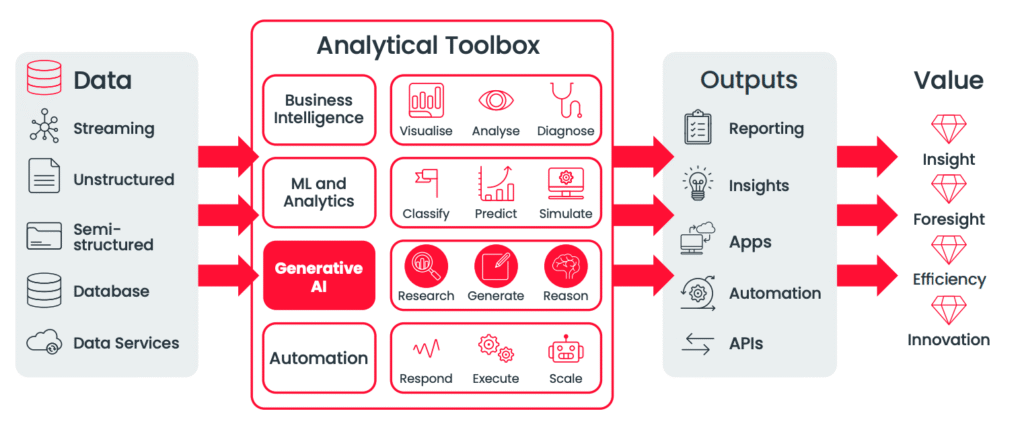
We desperately want you to think first about the insights that would drive better decisions. Picking the tool comes later.
Think of it this way: Generative AI is just another tool for extracting value from data. Powerful, yes. But still just a tool.
The magic happens when you combine AI with other analytical techniques. That well-designed dashboard isn’t going away. But augment it with AI that can explain anomalies? Now you’re talking. Use AI to clean and label messy, unstructured data so machine learning can work? That’s where value lives.
Look, we love Gen AI. But it’s just another tool in the box. Use it when it’s the right tool. Not because it’s the newest one.
2. Grab a Machete and Hack Through the Jungle
Once you see AI as a tool, not a religion, choosing the right technology gets easier.
But easier doesn’t mean easy. The AI landscape changes weekly. New models, new frameworks, new vendors. All promising to transform your business. It’s exhausting just keeping track.
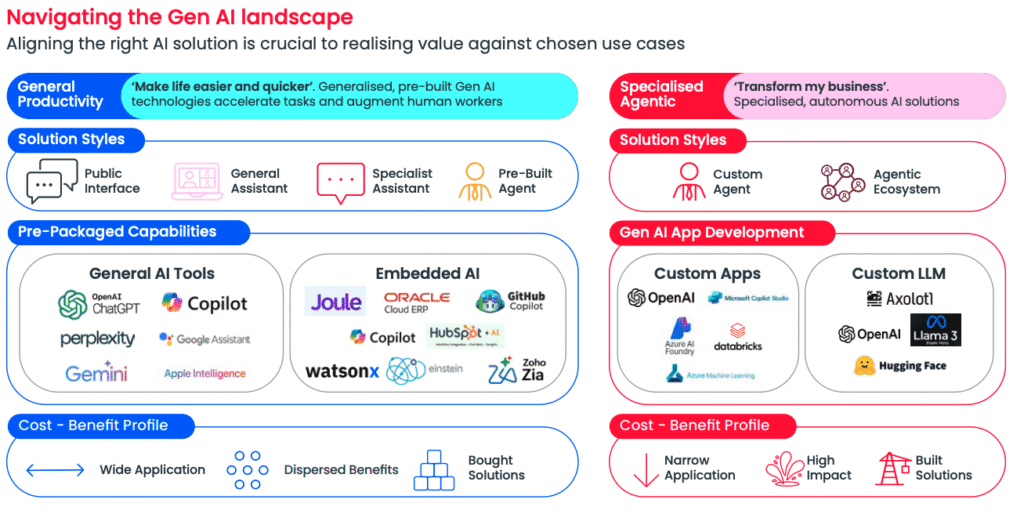
Here’s what matters: there are two ways of embedding AI into your organisation.
Want widespread but generalised productivity gains across your organisation? That’s one path.
Want deep transformation of specific processes? That’s another.
You can have both, but they won’t come from a single solution.
The productivity play:
Microsoft Copilot and similar tools work well here. Off-the-shelf, decent integration with SharePoint and Outlook, minimal training needed. Your organisation gets a general lift. Hard to calculate, but real. Emails write themselves. Meetings get summarised. Documents improve. Death by a thousand digital paper cuts, reversed.
The transformation play:
This is where things get interesting. And where most fail.
They take general productivity tools, like chatbots, and cram them into complex process changes. Like using a hammer to make a soufflé. Wrong tool, messy results.
Public ChatGPT doesn’t understand your thirty-year-old naming conventions. Desktop copilots can’t navigate your specific compliance requirements. They don’t know that Yany should be copied on all procurement emails and that your risk scores are calculated using a proprietary method.
For real transformation, you need AI built for your reality. Custom apps with your training data, your specific tools, your domain knowledge baked in. Not generic. Process-native.
At Oakland, we build exactly that. And here’s the fantastic news: when you define clear goals upfront, transformative change becomes measurable. Real ROI, not just “productivity vibes.”
3. Build Process-Native Solutions
Technology is great, but AI needs to fit into the complexity and pace of your organisation.
Any system that can’t cope with real-world complexity won’t survive. AI is no different. Advanced agentic solutions can excel at transformation, but only with
the right tools, training, and contextual awareness.
They need to understand your specific reality. The workarounds that keep things running. The exceptions that are now the rules. The human messiness accumulated over decades. Not the clean processes in your documentation. The actual way work gets done.
That’s why at Oakland, we don’t ask, ‘Are you ready for AI?’ We ask, ‘Is the AI ready for you?’
Your AI solutions must be more than add-ons. They should feel like natural parts of your workflows and decision chains.
This requires careful model training and task orientation. Plus, business adaptation and user upskilling. Technology alone won’t cut it.
For AI to land well, it needs deep integration into existing processes. Don’t invent new workflows. Don’t force people to change habits built over years. Projects only stick when AI is embedded into what already exists. Augments, not replaces.
The best AI is often invisible. Working alongside employees to make their jobs easier. Nobody notices the AI. They just notice they leave work on time.
To find these applications, think beyond chatbots. Where else can LLMs add value? Reading contracts? Categorising incidents? Spotting patterns across thousands of documents? Connecting dots humans would never see?
The power exists. Apply it where it can really help.
4. Firm Foundations (But Not Perfect Ones)
Gen AI needs data to work. We have said it throughout this guide, and it sounds obvious, but you’d be amazed at how many projects ignore this basic fact.
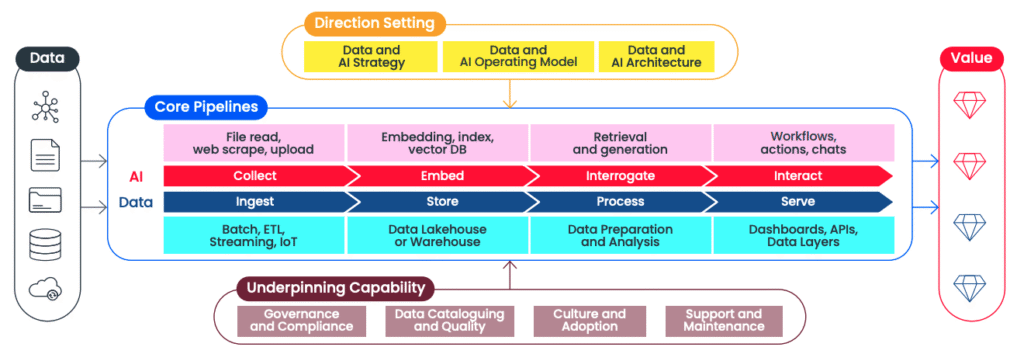
Many projects struggle to transition from proof-of-concept to production because of shaky data foundations. To succeed long-term, you need reliable data pipelines. Think of it as
building a supply chain for insights.
You do, of course, have data processes today. You’re doing something similar for reports and analytics. We’re just extending it to handle the messy, unstructured data that Gen AI can now process.
We use a simple framework to help our clients think through the challenges. Four steps for extracting insights from data: Ingest, Store, Process and Serve.
For Gen AI and unstructured data, we use a parallel framework:
- Collect – Gather unstructured data from various sources
- Identify what data solves your problem
- Build pipelines to get data where AI can read it
- Embed – Convert data to AI-readable formats
- Break down data so AI can interpret it
- Build tools to surface the right information
- Interrogate – Process and summarise the data
- Equip and prompt the AI to assemble insights
- Interpret information in the users’ context
- Interact – Deliver value to users
- Choose an interface: chatbot, alerts, automated actions
- Ensure insights reach the right people at the right time
Then add the wraparound to keep everything running: long-term strategy, compliance, assurance, platform, monitoring, optimisation. These might take time to build, but they aren’t optional extras. They’re what make AI part of your organisation, not just another tool gathering dust.
But here’s the crucial bit: don’t demand perfection.
Twenty years of data projects taught us this lesson. Try reforming everything from scratch? You’ll get stuck cleaning databases forever. Endless governance committees. Zero actual insights. If you wait for perfection, you’ll never start.
Pick processes you understand but know could be better. Get wins. Build momentum. Then strengthen the foundations.
That’s how progress happens.
The Oakland Difference
Those four principles aren’t just theory.
We’ve applied them with clients facing the messiest data challenges imaginable. They work because they acknowledge reality: AI success isn’t just about the technology. It’s about understanding your data, your processes, and your people.
So, how do you put this into practice?
How do you move from principles to progress?
Start focused. Stay practical. Don’t go it alone.
Making it Happen
Focus is a Superpower
So, what have we learned? The organisations winning with AI aren’t the ones with fifty proof-of-concepts. They’re the ones who picked their battles and nailed them.
Eight million products categorised. Thousands of lessons made searchable. Finance teams freed from SQL purgatory. These weren’t moonshots. They were focused, practical solutions to specific problems.
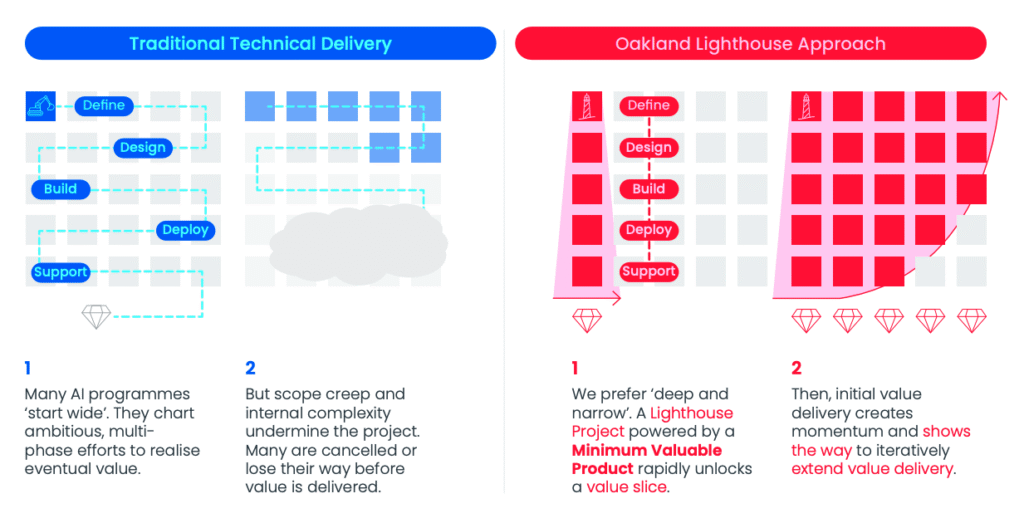
We call them Lighthouse Projects. Not because they’re flashy but because they show the way.
Here’s what works:
Pick one painful problem. The information tsunami drowning your customer service team. The document mountain hiding critical lessons. The expertise bottleneck slowing every decision.
Go deep. Really understand the process, the people, and most importantly, the data. Build AI that fits your specific reality. Not generic tools. Process-native solutions that stick.
Build it to last. No throwaway demos. No technology tourism. Actual solutions solving actual problems. Saving hours daily is not a proof-of-concept for the finance team. That’s value.
Here’s what doesn’t work:
The scattergun approach always fails. Twenty half-finished projects. Teams stretched thin. Budget scattered. Everyone frustrated. This is what drives organisations headlong into Gartner’s AI trough of disillusionment.
‘Big bang’ transformations don’t work either. Nobody’s waiting five years for your AI strategy to deliver. By then, the technology will have moved on three times over.
The compound effect:
Your first Lighthouse Project does more than solve one problem. It builds belief. It creates advocates. It develops capability. Most importantly, it teaches you what AI can do for your specific business.
The finance team’s success with AI becomes the blueprint for operations. The lessons-learned system becomes the model for customer service. Each success makes the next one easier, faster, cheaper.
That’s how you build momentum. Not with grand strategies and transformation roadmaps. Your focused wins will compound into a competitive advantage and efficiency gains.
In the fast-moving world of AI, perfect is the enemy of good. Start narrow. Go deep. Build something real. The rest will follow.
How Oakland Can Help
Oakland and Softcat: Two Powerhouses, One Purpose
We’ve spent 40 years helping businesses unlock serious value from their data. Now as part of the Softcat family, we’re combining Oakland’s deep data expertise with Softcat’s unrivalled IT infrastructure and vendor relationships.
We’re still the same straight-talking, client-obsessed Oakland team, operating independently with our own voice and values. But backed by one of the UK’s most trusted tech partners, we deliver even more firepower for your data and AI challenges.
AI Consulting
We meet you wherever you are on your AI journey and stick by your side as your hands-on partner. From strategy to implementation, we support every aspect of your transformation:
- Data and AI Strategy
- AI Governance and Compliance
- Data Management
- Data and AI Architecture
- Data and AI Platform Implementation
- AI Solution Review
AI Solutions
We design, build and deploy customised
AI-powered solutions that integrate
seamlessly into your business processes:
- AI Use Case Discovery
- Custom Agentic AI solutions
- Building chatbots and Co-pilots
- AI Engineering
Start with Our AI Discovery Workshop
Not sure where to begin? In three hours, we’ll cut through the noise to identify real AI opportunities for your business. No jargon, no vendor pitches, just practical exploration that moves you from strategy to action.
You’ll walk away with prioritised use cases, clarity on ROI, and concrete next steps.
Book your workshop today: hello@weareoakland.com | 0113 234 1944